Launch offer — valid today only

📄 Digital book in PDF · read it on your phone or print it

Classic Car Carburettors Illustrated: Every Job in Drawings Strip, Rebuild and Tune It in the Same Order Every Time

Float level, needles and jets, damper oil, idle speed, mixture, twin carb balancing, plug reading and fault-finding by symptom, including 'it ran better before I touched it'. Every topic has its own page: the drawing first, then what you need to remember. 69 illustrated pages.

YES, I WANT THE ILLUSTRATED CARB BOOK

🔒 Secure checkout · PDF by email · 30-day guarantee

Every topic, its own pageEach setting drawn, with the explanation beside it
69 illustrated pages9 parts, from how a carburettor works to the bench review
Up-to-date sourcesYour car's workshop manual, the carb maker's specifications and UK E10 fuel guidance
PDF by emailFormat

Look Inside the Book

Every page has one big drawing and a panel with the settings and steps you need to know:

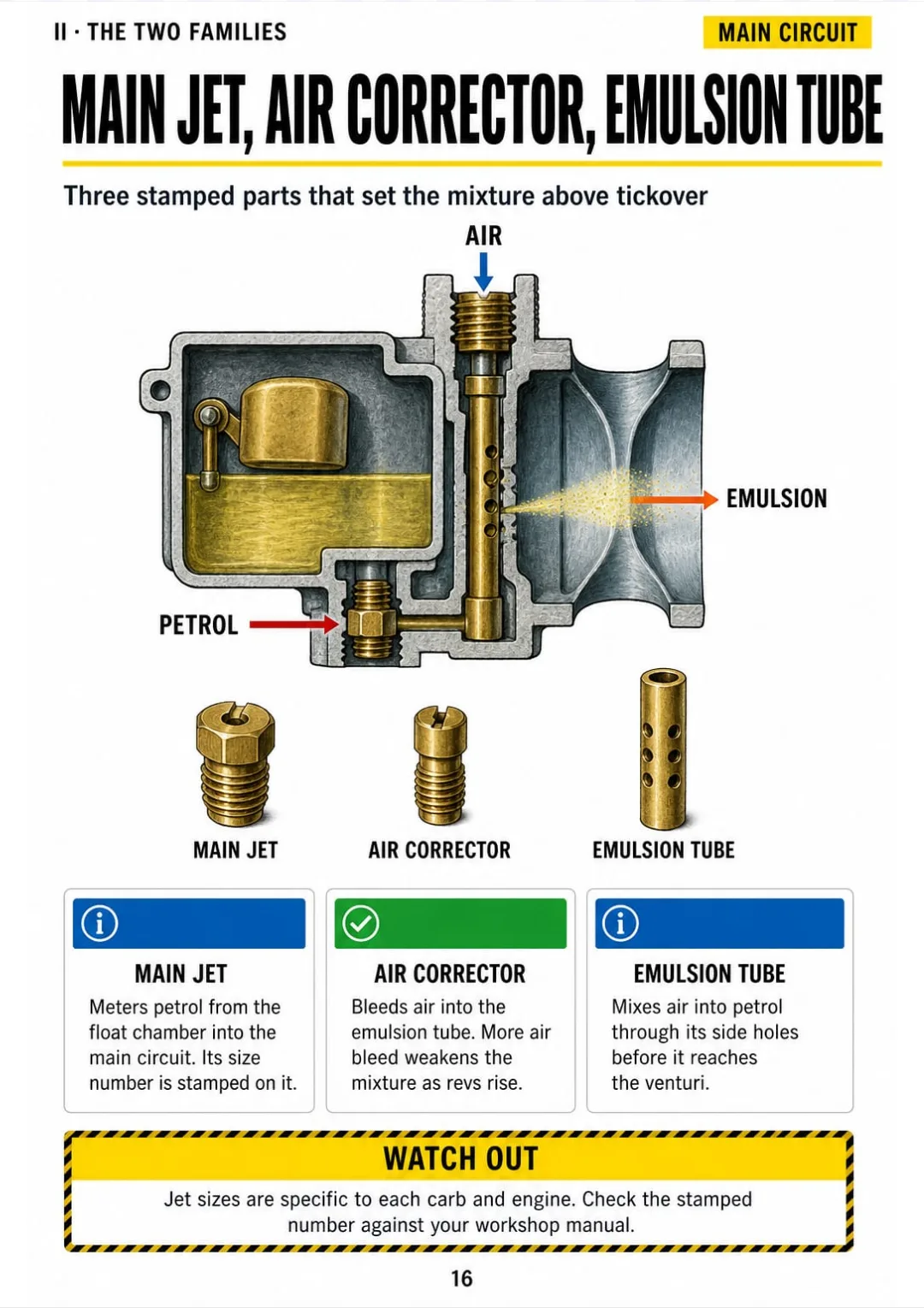
Petrol through the main jet, air through the corrector, mixed in the emulsion tube
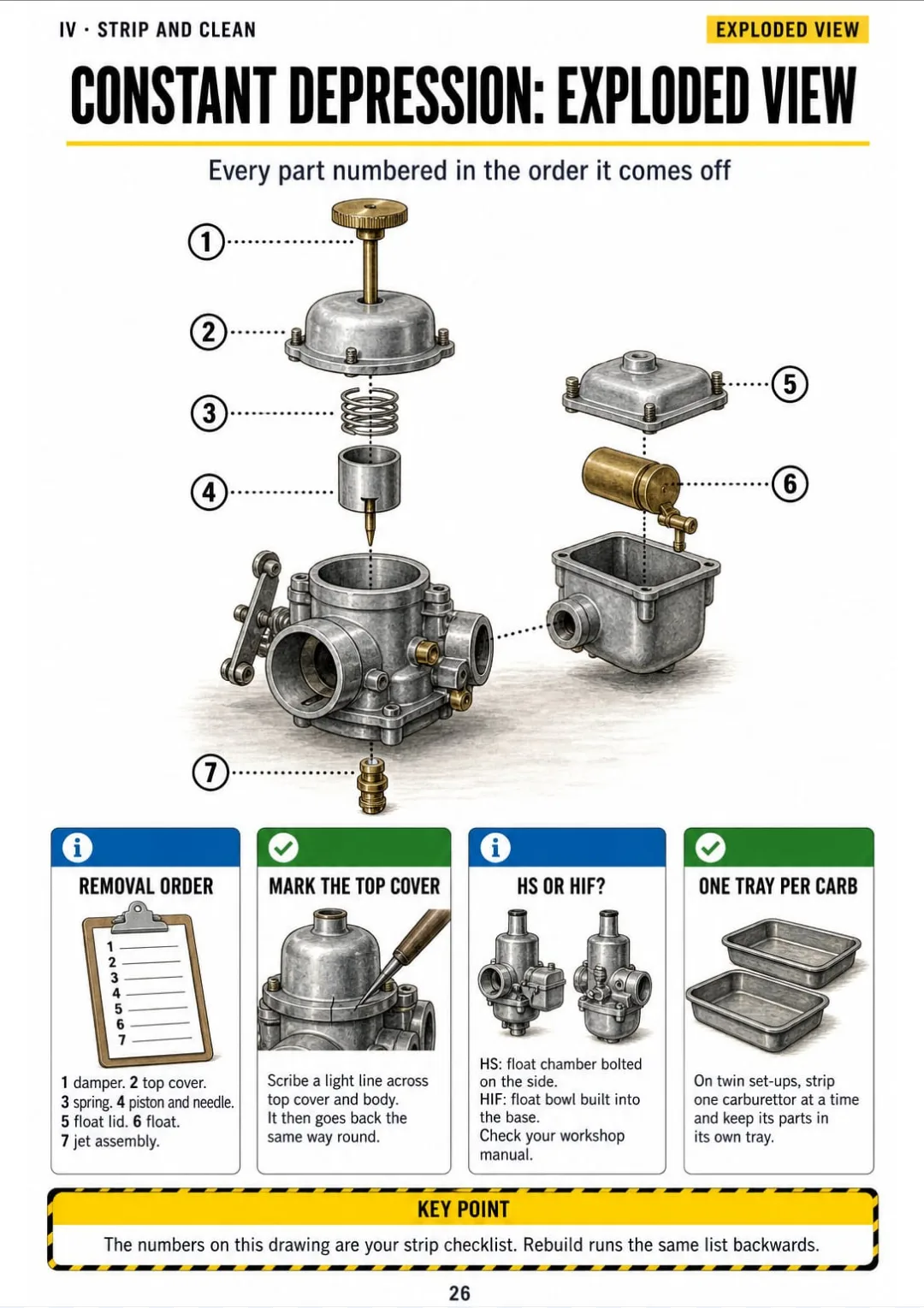
Seven parts, numbered 1 to 7 in removal order: damper first, jet assembly last.
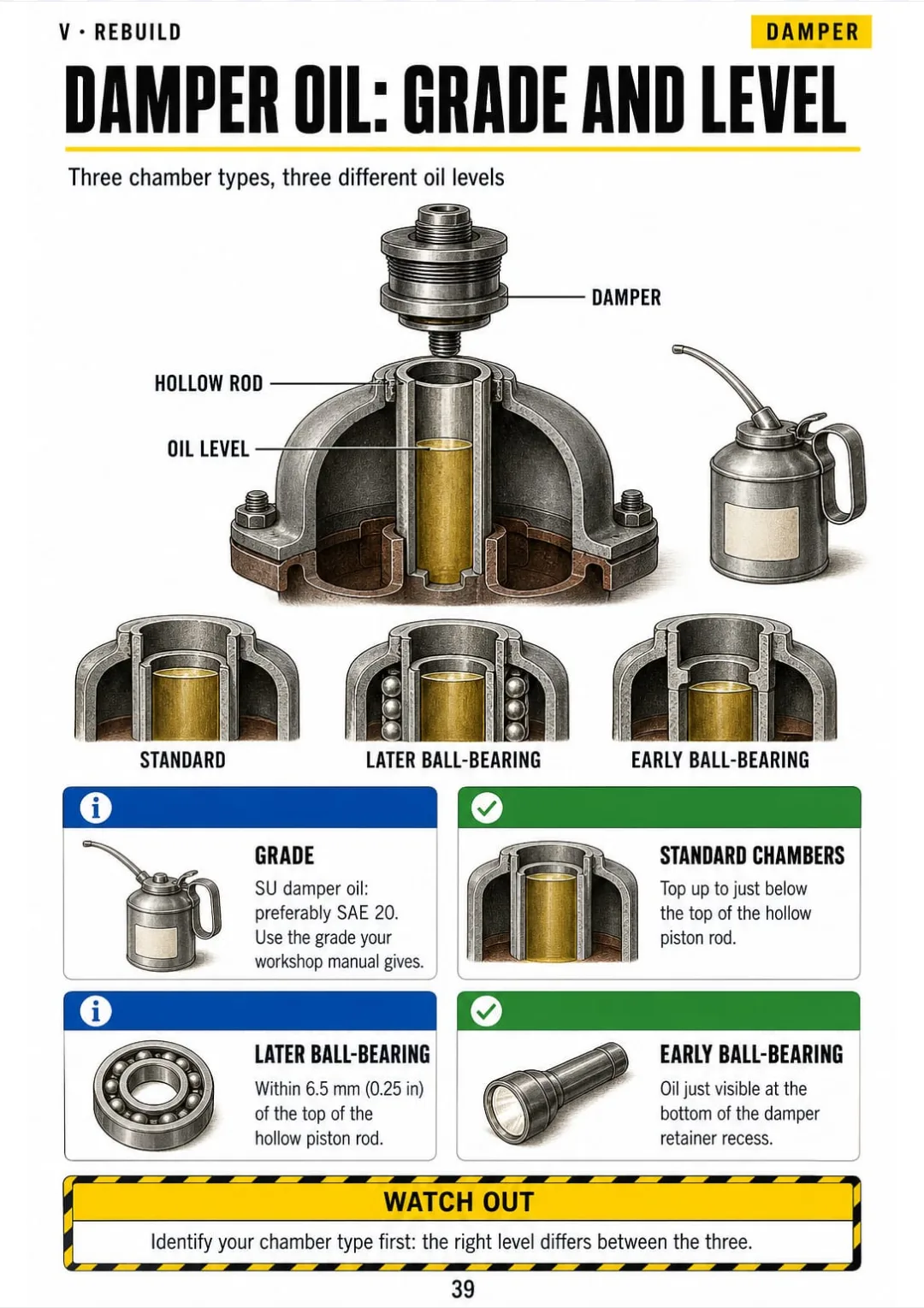
Damper oil: SAE 20 preferred; later ball-bearing chambers within 6.5 mm of the rod top.
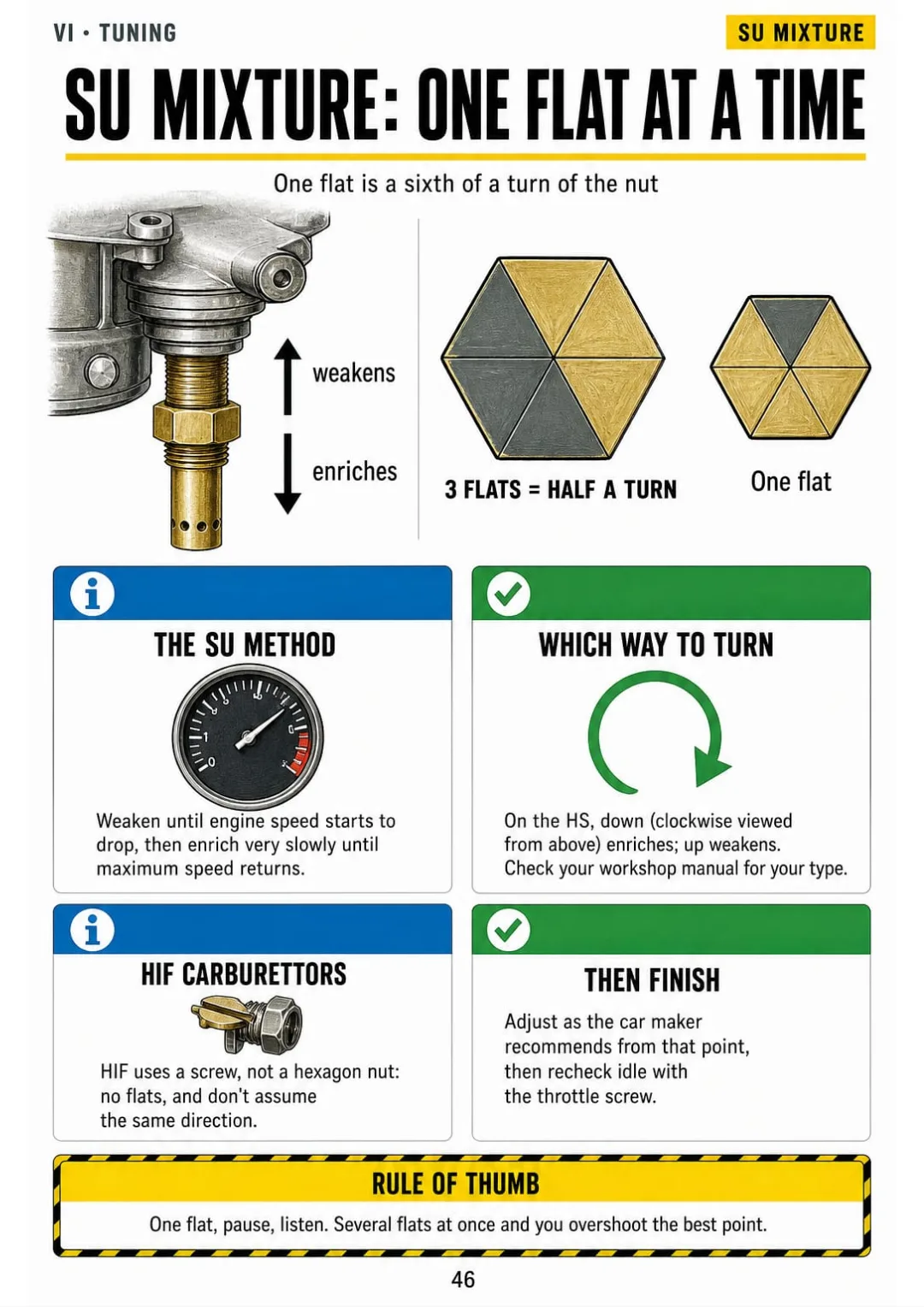
One flat is a sixth of a turn: weaken until speed drops, then enrich until it returns.
Tan is right, black soot is rich, white is hot, wet oil isn't the carb
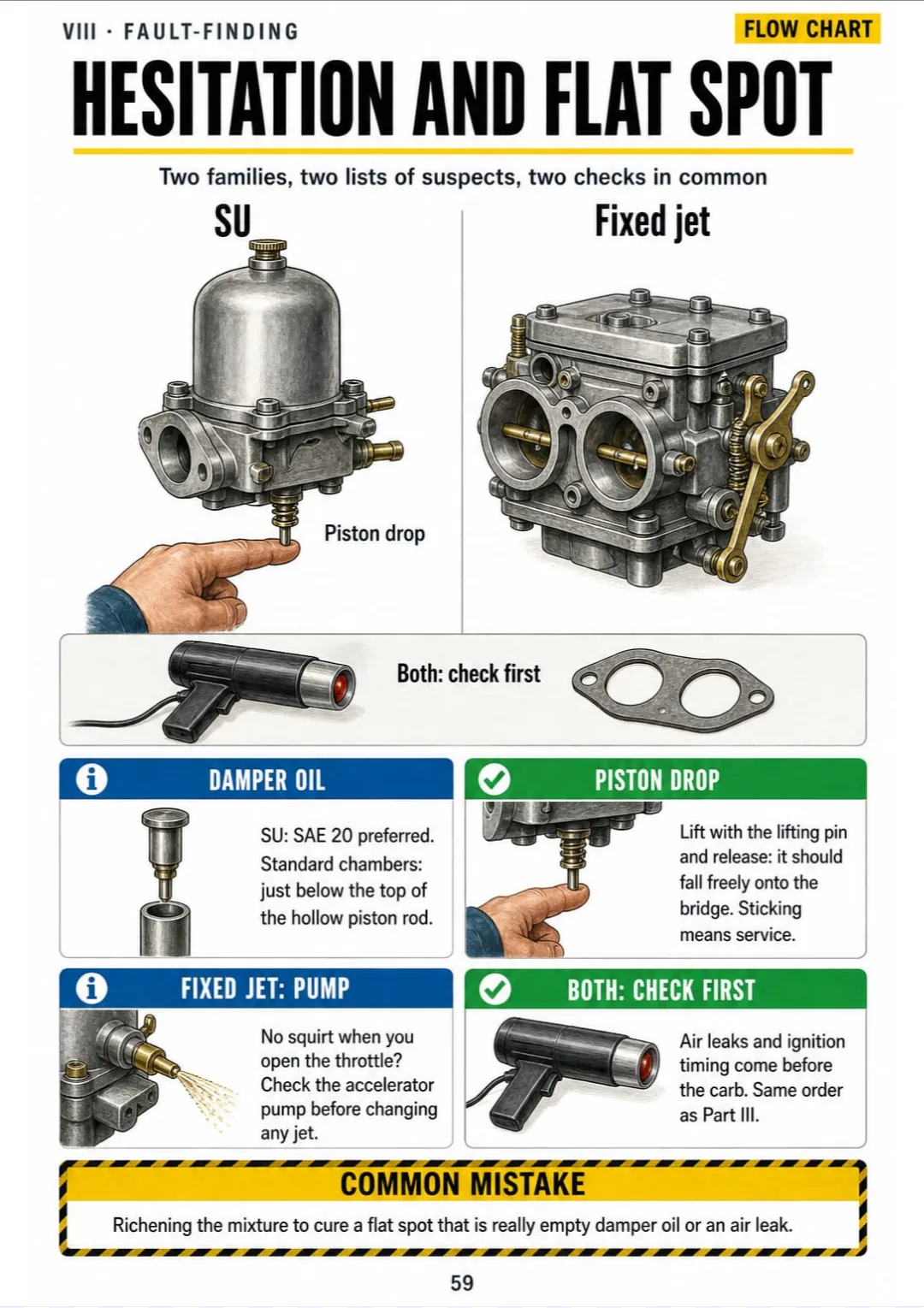
SU: damper oil, piston drop, needle. Fixed jet: pump and progression holes.
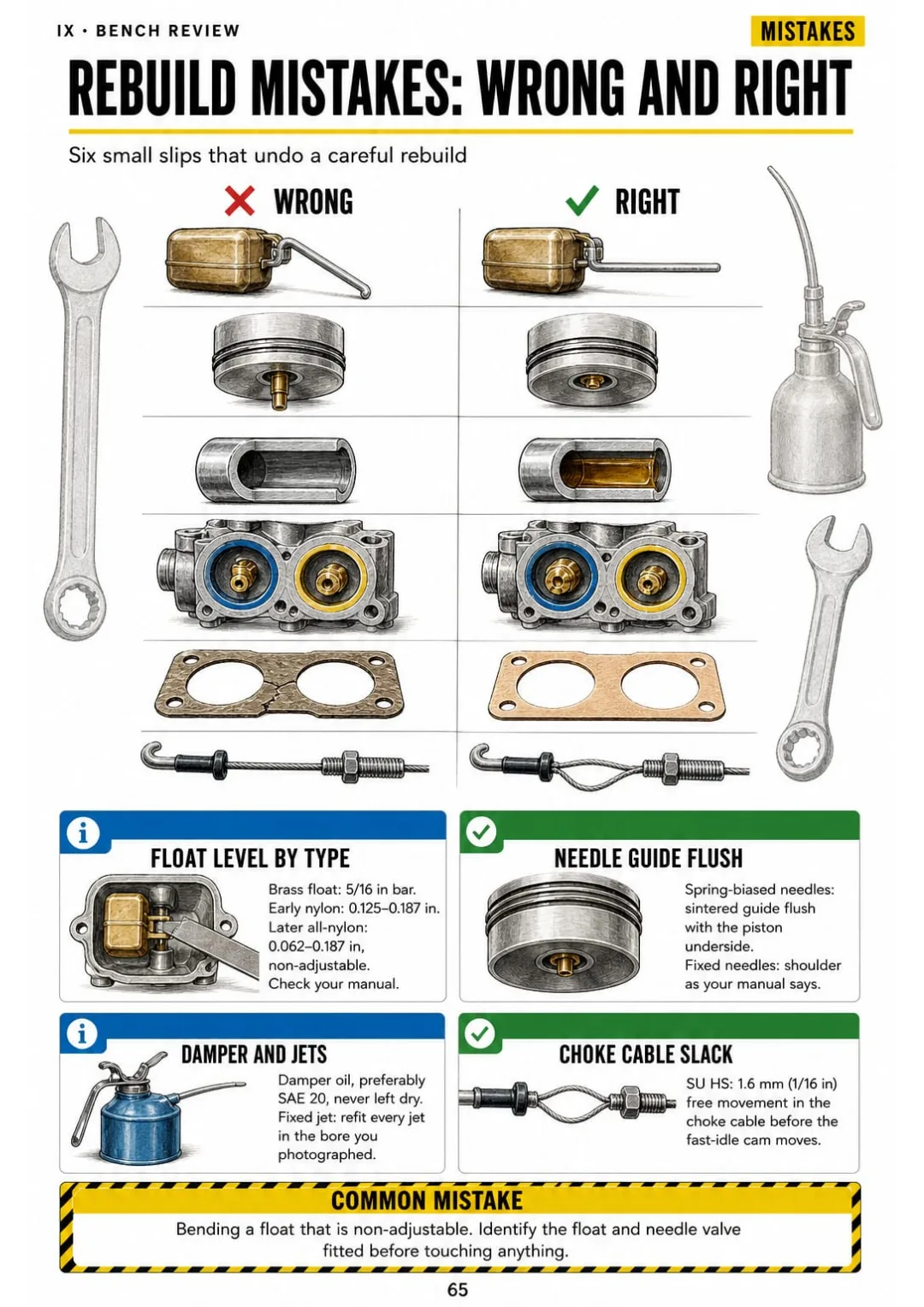
Six rebuild mistakes drawn wrong and right: float, needle, damper, jets, gasket, linkage
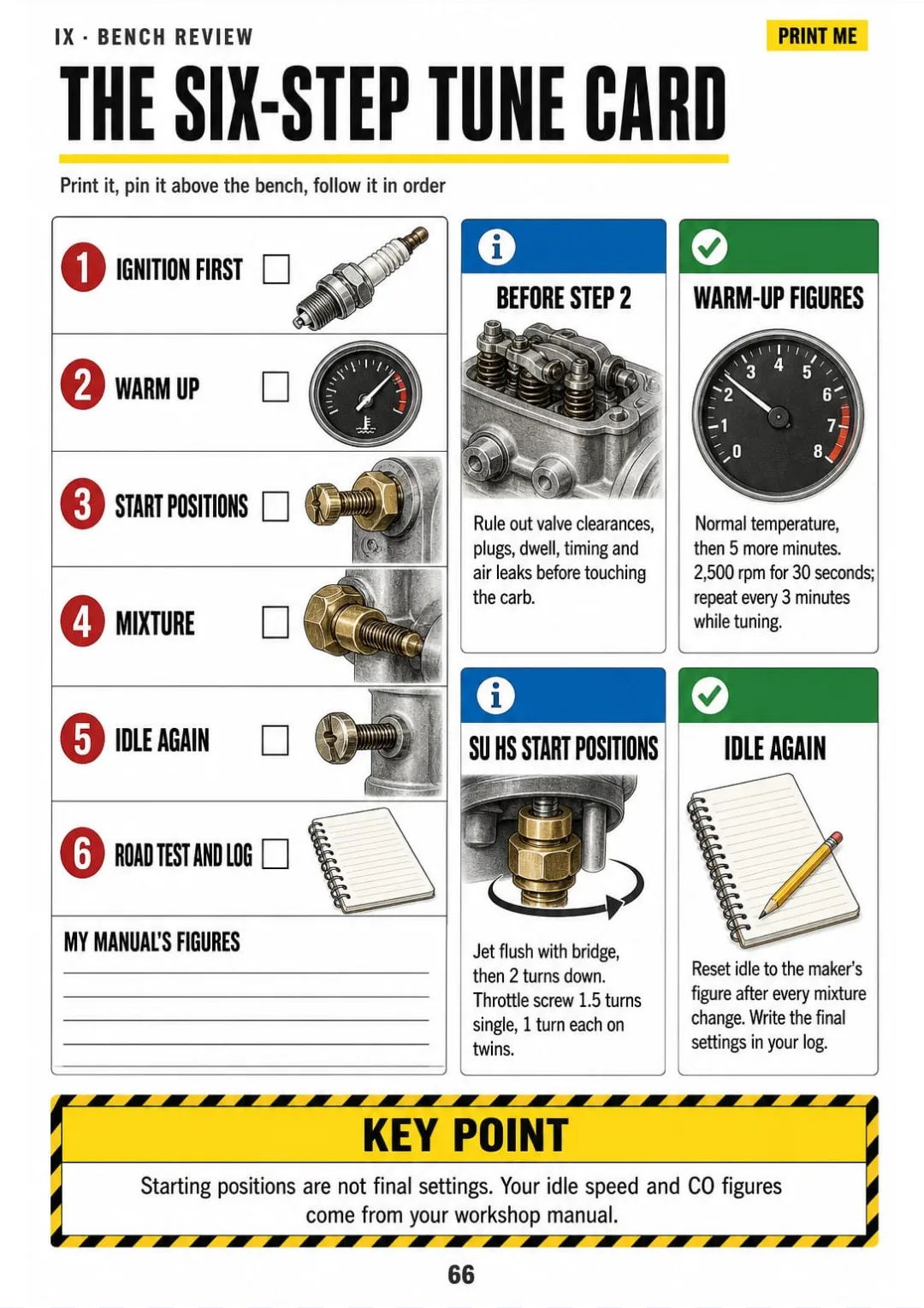
Six steps, one check each, and a blank panel for your manual's figures

Swipe to see more →

These are real pages from the book. The table of contents is the full one: 9 parts and 65 topics.

The Problem Isn't You. It's How It Was Explained to You.

You're at the bench with the damper cap off, the rod in one hand and a bottle of oil in the other. And you're not sure how far to fill it.

The workshop manual covers it in one paragraph, tucked between the piston and the jet. It names the oil, but doesn't show where the level sits on your type of chamber. So you guess, top it up and hope the car doesn't hesitate on the first drive.

Damper oil: SAE 20 preferred; later ball-bearing chambers within 6.5 mm of the rod top.

In the book, damper oil gets a page of its own. The damper is drawn in section, with the oil level marked against the rod: SAE 20 preferred, and on later ball-bearing chambers, the oil sits within 6.5 mm (about ¼ in) of the top of the hollow piston rod. A panel reminds you to check the figure in your workshop manual.

Float level, centring the jet, the piston drop test, setting the mixture one flat at a time and balancing twin carbs work the same way: each one has its own page.

You see it, you understand it and you do it at the bench, without hunting through the manual again.

COMPARE FOR YOURSELF

The Same Topic, Two Ways to Learn It

THIS
  • The manual: line after line
  • Strip-downs explained only in words
  • You get to the bench still unsure
Dismantling of the constant-depression carburettor should proceed in the following sequence. First unscrew and withdraw the hydraulic damper assembly from the top of the suction chamber. Then remove the securing screws and lift the suction chamber vertically, taking care that the piston and needle are not tilted. Withdraw the piston spring and the piston complete with needle. Next detach the float chamber lid, remove the float and needle valve, and finally disconnect and withdraw the jet assembly, noting the position of all washers and glands.
FOR THIS
  • The strip-down in one drawing
  • The removal order in a numbered panel
  • You see it and it makes sense
Seven parts, numbered 1 to 7 in removal order: damper first, jet assembly last.
CONTENTS

Take a Look at the 9 Parts and 65 Topics

How it works, the two families, checks before you start, strip and clean, rebuild, tuning in order, twin carbs and plugs, fault-finding by symptom and the bench review: 69 pages, all illustrated

IHow a carburettor works · pp. 5-11
  1. What a carburettor actually does
  2. Venturi and depression: why petrol rises
  3. Rich, lean and about right
  4. The float chamber: a constant petrol level
  5. The throttle: you control air, not petrol
  6. Cold starts: choke and enrichment
  7. The anatomy map: every part named
IIThe two families · pp. 12-18
  1. Constant depression or fixed jet: which one is yours
  2. Constant depression: how the piston rises
  3. The tapered needle: the mixture curve in metal
  4. The hydraulic damper: the accelerator pump you can't see
  5. Fixed jet: main jet, air corrector and emulsion tube
  6. Fixed jet: idle circuit and progression holes
  7. Fixed jet: the accelerator pump
IIIBefore you touch the carb · pp. 19-25
  1. Ignition first, carburettor second
  2. Air leaks: the hidden lean mixture
  3. Petrol supply: pump, filter and pressure
  4. E10, E5 and your classic's rubber
  5. Air filter and heat: two quiet mixture changers
  6. Tools for the bench
  7. Photograph, label, then remove
IVStrip and clean · pp. 26-33
  1. Constant depression: the exploded view
  2. Removing the piston without bending the needle
  3. Fixed jet: the exploded view
  4. Inside the float chamber: what dirt tells you
  5. Cleaning jets: what to use and what never to use
  6. Diaphragms and rubber: inspect, don't soak
  7. Throttle spindle wear check
  8. The parts to renew every time
VRebuild · pp. 34-41
  1. Reassembly order: the reverse, with checks
  2. Setting the float level
  3. Fitting the needle: fixed or spring-biased
  4. Centring the jet
  5. The piston drop test
  6. Damper oil: grade and level
  7. Fixed jet: jets back in the right place
  8. Linkages, return springs and full throttle
VITuning in the same order · pp. 42-51
  1. The method: six steps, always in this order
  2. Warm up properly first
  3. Setting initial positions
  4. Idle speed: set it, then set it again
  5. Constant depression mixture: one flat at a time
  6. The lifting pin test
  7. Fixed jet mixture: lean best idle
  8. Colour flame and vacuum gauge: what they show
  9. Road test: what to feel and when
  10. The settings log: write it before you forget it
VIITwin carbs and spark plugs · pp. 52-57
  1. Twin carbs: why balance matters
  2. Uncoupling the linkage
  3. Balancing air flow: meter or hose
  4. Balancing mixture on twin carbs
  5. Reading spark plugs: the colour chart
  6. One plug different from the rest
VIIIFault-finding by symptom · pp. 58-64
  1. Hard starting, hot or cold
  2. Hesitation and flat spot on acceleration
  3. Hunting or uneven tickover
  4. Flooding and petrol smell
  5. Popping back and running hot
  6. Black smoke and heavy fuel use
  7. It ran better before I touched it
IXBench review · pp. 65-69
  1. Frequent rebuild mistakes, drawn wrong and right
  2. The six-step tune card
  3. Winter lay-up and spring start-up
  4. When to call a specialist
  5. Glossary of carb words

One Page, One Topic, All Clear

Think of it this way:

It's a Saturday in March, the first club run is next weekend and the car is hunting at tickover. You need to set the mixture, and you'd like to get it right first time.

You open the book at the mixture page and see the adjusting nut drawn with its flats: one flat is a sixth of a turn. Weaken until the speed drops, then enrich until it comes back.

Tan is right, black soot is rich, white is hot, wet oil isn't the carb

Float level, centring the jet, balancing twin carbs, reading the plugs and the flat spot on acceleration work the same way: each one on its own page.

Classic Car Carburettors Illustrated is 9 parts and 65 topics, all drawn, with fault-finding flow charts, a six-step tune card and a glossary at the end.

What you see drawn, you don't have to memorize.

What's Inside Classic Car Carburettors Illustrated:

Ipp. 5-11

How a carburettor works

What a carburettor does, venturi and depression, rich and lean, the float chamber, the throttle, cold starts and the full anatomy map.

IIpp. 12-18

The two families

Constant depression or fixed jet, the rising piston, the tapered needle, the hydraulic damper, main jet and emulsion tube, the idle circuit and the accelerator pump.

IIIpp. 19-25

Before you touch the carb

Ignition first, air leaks, petrol supply and pressure, E10 and your rubber parts, air filter and heat, bench tools and labelling before removal.

IVpp. 26-33

Strip and clean

Both exploded views, removing the piston safely, what float chamber dirt tells you, cleaning jets, diaphragms, spindle wear and the parts to renew.

Vpp. 34-41

Rebuild

Reassembly order, float level, fitting the needle, centring the jet, the piston drop test, damper oil, jets back in place and linkages.

VIpp. 42-51

Tuning in the same order

Tune it in six steps, always in the same order: warm-up, initial positions, idle speed, mixture for both families, the lifting pin test, colour-flame plug check and vacuum gauge, road test and a settings log to note what worked.

VIIpp. 52-57

Twin carbs and spark plugs

Why twin carbs need balancing, uncoupling the linkage, airflow by meter or hose, balancing mixture and reading spark plugs by colour.

VIIIpp. 58-64

Fault-finding by symptom

When it misbehaves, start from the symptom: hard starting, hesitation, hunting tickover, flooding, popping back, black smoke and 'it ran better before I touched it', each one a flow chart to follow.

IXpp. 65-69

Bench review

Frequent rebuild mistakes drawn wrong and right, the six-step tune card, winter lay-up, when to call a specialist and a glossary.

At the end of the book: Fault-finding flow charts by symptom, a six-step tune card, a settings log page and a glossary.


Plus: 2 Free Books

Carburettor Fault Cases: Practice Workbook

BONUS 1: «Carburettor Fault Cases: Practice Workbook»

Value on its own: US$ 17.90

Practise reading real-world symptoms (hesitation, flat spots, flooding, hunting at tickover) and work out the likely cause on paper before you touch a single screw.

Common Carb Mistakes: Before & After Cards

BONUS 2: «Common Carb Mistakes: Before & After Cards»

Value on its own: US$ 14.90

The most frequent slips that undo a careful rebuild, each drawn wrong and right on one card, so you can check your work at the bench.

Classic Car Carburettors Illustrated with 2 Free Books

  • Classic Car Carburettors Illustrated: 69 illustrated pagesUS$ 63
  • BONUS 1: Carburettor Fault Cases: Practice WorkbookUS$ 17.90
  • BONUS 2: Common Carb Mistakes: Before & After CardsUS$ 14.90
  • High-resolution PDF to printIncluded
Total value US$ 95.80
YOUR PRICE:
US$ 27
You save US$ 68.80
YES, I WANT CLASSIC CAR CARBURETTORS ILLUSTRATED FOR US$ 27

📄 This is a digital PDF book sent to your email: nothing is printed or shipped.

Secure purchaseEncrypted payment30-day guarantee

PDF by email: We email you Classic Car Carburettors Illustrated as a PDF, together with the two free books. It's a single payment: no installments, no extra charges.

Who This Book Is For

Your first carb strip-down

Your first carb strip-down

Every part is drawn in removal order, so you know what comes out first and where it goes back.

Getting it ready for spring

Getting it ready for spring

Six tuning steps in the same order every time, so the set-up is done properly before the first run of the season.

You've done it for years

You've done it for years

Fault-finding flow charts by symptom and a settings log, so you can go back to the set-up that ran best instead of starting again.

Everything You Get Today

US$ 95.80US$ 27
YES, I WANT CLASSIC CAR CARBURETTORS ILLUSTRATED FOR US$ 27

📄 This is a digital PDF book sent to your email: nothing is printed or shipped.

30DAYS
GUARANTEE

30-Day Guarantee

Try Classic Car Carburettors Illustrated for 30 days, bonus books included.

We refund everything if the file won't open, if the book isn't what you see here, if you were charged twice or if the email doesn't arrive. Just email us.

You pay once. No subscriptions.

Frequently Asked Questions

Is it for me whether my car has constant-depression or fixed-jet carbs, single or twin?

Yes. The book covers both families, single and twin set-ups. Constant depression is the rising-piston type, such as SU and Stromberg; fixed jet covers types such as Weber, Dellorto and Solex. It starts with how a carb works, so it suits a first strip-down as well as someone who's done it for years.

Where does the content come from?

It's built around the way carburettors are set up in manufacturers' workshop manuals. Every figure is marked "check your workshop manual", because jets, needles and float heights vary by car.

Is it official material?

No. It's an independent illustrated guide. Makers and models are named only to describe what it covers, and it isn't affiliated with any carburettor maker, vehicle manufacturer or club.

Does it replace my workshop manual or a specialist?

No. It helps you understand and follow the job in order. Your car's specifications come from your workshop manual, and some jobs are best left to a specialist: the book has a page on when to call one.

I already have the workshop manual and old magazines. What does this add?

The order and the drawings. Your manual gives your car's figures; this book shows each job on its own page, in the order you do it at the bench, with fault-finding flow charts by symptom: hesitation, hunting tickover, 'it ran better before I touched it'. Keep the manual for the figures and the book for the how.

When and how does it arrive?

The book and the 2 gifts arrive as PDFs by email, at the address you enter when you pay.

Do I have to pay every month?

No. It's a one-off payment, with no subscription.

Can I have it on paper?

Yes. The PDF is made to print, so you can keep the pages you need on the bench in the garage.

How does the refund work?

You have 30 days. We refund everything if the file won't open, if the book isn't what you see on this page, if you were charged twice or if the email doesn't arrive: just email us.

Before You Close This Page

No more rereading the manual and still guessing.

The damper oil level, drawn so you see it at a glance.

You get to the bench knowing where every part goes.

Drawings make studying faster.

The book is right below.

One-time payment: US$ 27 · Guarantee: 30 days · PDF by email

YES, I WANT CLASSIC CAR CARBURETTORS ILLUSTRATED FOR US$ 27

📄 This is a digital PDF book sent to your email: nothing is printed or shipped.